The global massage device market is experiencing explosive growth. According to industry research, the global market size reached USD 10.2 billion in 2024 and is projected to climb to USD 31.53 billion by 2035, with a compound annual growth rate (CAGR) of up to 10.8%. For brands and distributors looking to enter this blue-ocean market, choosing a reliable massage equipment manufacturer is the first step toward success.
This article provides you with a systematic procurement evaluation framework, helping you screen potential partners across four dimensions: certifications, products, customization capabilities, and supply chain resilience.
1. Core Certifications: Safety and Compliance Are Non-Negotiable
Massage devices make direct contact with the human body and often involve heating and electronic drive modules. Therefore, international certifications are the primary indicator of a manufacturer’s professionalism. When evaluating suppliers, always confirm they hold the following credentials:
- CE Certification: The mandatory safety mark for entering the European market
- RoHS Certification: Ensures products are free from lead, mercury, and other hazardous substances
- FDA Registration (if targeting the U.S. market): Required for devices with medical claims
- ISO 9001: The international standard for quality management systems
Procurement Tip: Ask the manufacturer to provide original certification documents or official verification links, rather than relying solely on markings on sample units. A compliant massage equipment manufacturer should maintain a complete quality traceability system.
2. Product Portfolio Completeness: Reducing Multi-Supplier Management Costs
Mature brands typically need to build a complete product line rather than relying on a single hit product. Therefore, prioritizing manufacturers that can provide a full range of massage equipment significantly reduces supply chain complexity.
An ideal partner should cover the following core categories:
| Category | Application Scenarios | Market Growth Drivers |
| Waist Massager | Handheld units account for 24%; portability is the dominant trend | Sedentary lifestyles driving lumbar issues; back/waist massagers hold 29% of the overall market share |
| Heated Knee Massager | Arthritis patients, sports rehabilitation, senior care | Approximately 350 million people worldwide suffer from arthritis; heat-integrated devices are growing at 44% |
| Percussion Therapy Device | Fitness enthusiasts, physical therapy, athletic recovery | The fastest-growing sub-category, with an expected CAGR of 9% |
| Neck & Shoulder Massager | White-collar workers, business travelers | Handheld units account for 24%; portability is the dominant trend |
Manufacturers with a full-spectrum product line (from handheld devices to massage chairs) can help you rapidly build a brand matrix and flexibly adjust your SKU mix based on market feedback.
3. OEM/ODM Customization Capabilities: The Core of Brand Differentiation
In the highly competitive massage device market, product homogenization is the greatest risk. Industry observations show that top-tier brands hold a combined 43% market share, while emerging brands rely on differentiated design to compete for the remaining 20% of the space.
Therefore, a manufacturer’s customization capabilities directly determine whether your brand can stand out. When evaluating, focus on the following:
1. Industrial Design
Does the manufacturer have a design team capable of moving from concept sketches to 3D prototypes? Can they adjust the aesthetic language according to target market preferences (e.g., minimalism for North America, medical professionalism for Europe)?
2. Functional Customization
- Massage mode programming (e.g., kneading/tapping/heat combinations for waist massagers)
- Smart connectivity (APP control, AI pressure mapping—currently 52% of new products integrate smart features)
- Battery life and charging solution optimization
3. Private Label Branding
From logo laser engraving and custom color schemes to packaging design, comprehensive private-label services allow your products to maintain consistent brand recognition at the point of sale. An excellent manufacturer should provide end-to-end support from sample to mass production, including 3D prototyping and small-batch trial production.
4. Supply Chain Flexibility: From Small-Batch Validation to Large-Scale Expansion
For new entrants or brands testing new markets, flexible minimum order quantities (MOQ) are critical. An ideal manufacturer should support:
- Small-batch sample stage: 50–100 units for market testing or crowdfunding validation
- Medium-batch ramp-up stage: 500–2,000 units for channel distribution
- Large-batch stable stage: 5,000+ units for cost optimization
Additionally, production lead times and delivery stability are key metrics. The massage device market has distinct seasonality (e.g., year-end holiday season and Mother’s Day), and supply chain responsiveness directly impacts inventory turnover rates.
5. Partnership Model Recommendation: Long-Term Collaboration Over One-Off Transactions
Massage devices follow a durable goods + repeat accessory purchase business model, with high customer lifetime value (LTV). Therefore, establishing a long-term strategic partnership with a manufacturer—rather than purely price-driven procurement—offers the following advantages:
- Co-development: Sharing market insights to lay out next-generation products 6–12 months in advance (e.g., the currently trending AI-driven personalized massage)
- Cost Optimization: Long-term orders secure better raw material pricing and production scheduling priority
- After-Sales Support: Including firmware upgrades, spare parts supply, and remote diagnostic technical support
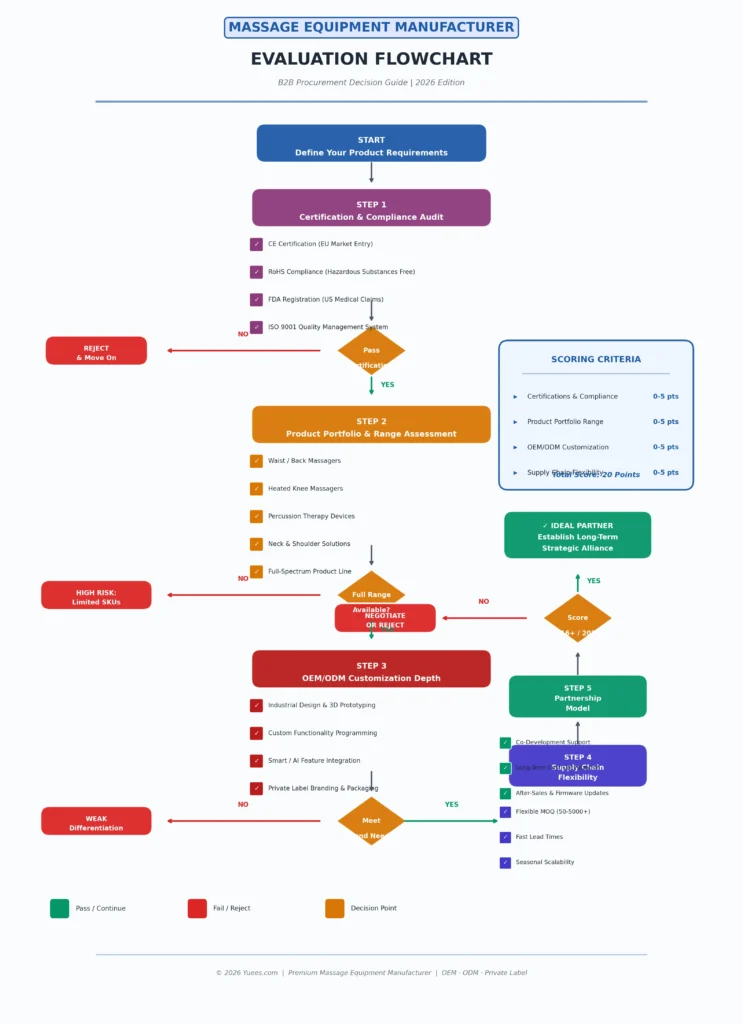
Summary: Your Manufacturer Evaluation Checklist
Before making a final decision, score against the following checklist (1–5 points per item, total 20 points):
| Evaluation Dimension | Key Questions |
| Compliance & Certifications | Do they hold CE/RoHS/FDA and other certifications required by your target markets? |
| Product Coverage | Can they provide a full range of products including waist, knee, and percussion therapy devices? |
| Customization Depth | Do they support full-process customization from structural design to packaging? |
| Supply Flexibility | Do they accept small-batch MOQs and guarantee delivery timelines? |
Choose the partner with the highest score, and your brand will be well-positioned in the USD 31.53 billion global massage device market.